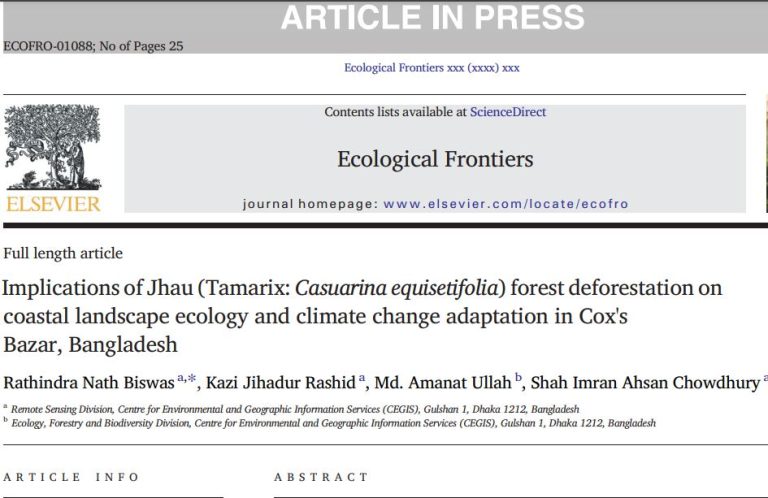
I am thrilled to announce that our study on the deforestation of Jhau (Tamarix: Casuarina equisetifolia) forests and its impacts on coastal landscape ecology and climate change adaptation in Cox's Bazar, Bangladesh, has been published in the prestigious Elsevier journal.
Our comprehensive research focused on the drivers of deforestation, health dynamics, biomass and carbon estimation, as well as the soil chemical and wood pathological impacts of the Jhau forest.
Key Findings
Using high-resolution WorldView 3/4 satellite imagery, we delineated Jhau patches from 2005 to 2023, offering a detailed change and loss analysis with advanced GIS tools and techniques. Our research highlights the significant role of coastal erosion as the primary driver of Jhau forest deforestation, accounting for 52% of plantation losses over the studied period.
We also assessed the health dynamics of the Jhau forest through geophysical indices like the Enhanced Vegetation Index (EVI) and Leaf Area Index (LAI) using Landsat Mission Images within the Google Earth Engine Platform. The analysis revealed a notable decline in LAI, particularly in the West Cox's Bazar Cricket Stadium Cluster, indicating severe degradation of forest health.
Implications for Climate Change Adaptation
The findings emphasize the importance of Jhau forests in mitigating climate change risks and adapting to coastal environmental changes. Our comprehensive assessment of soil chemical elements and wood pathological concentrations provides crucial data for developing effective afforestation and green belt strategies.
Our study aims to inform and guide the implementation of robust afforestation schemes and green belt development strategies to enhance climate resilience and adaptation for coastal communities.
© 2024 All Rights Reserved by Kazi Jihadur Rashid.